
The Kawasaki Versys 900 is official: Kawasaki Motors Europe revealed the all-new mid-size tourer on 13 October, and it slots in between the Versys 650 and the Versys 1100. It runs a 948 cc in-line four from the Z900 family, rated at 122 PS (89.6 kW) at 9,500 rpm, and it's the first Versys with radar-based rider aids. Both versions are expected in Australia and New Zealand by mid-2027, with local pricing still to be announced. Here are the numbers first, from Kawasaki and the motorcycle press, then what the bike means for riders here.
Quick stats
| Item | Kawasaki Versys 900 |
|---|---|
| Price | UK £10,899, SE £11,799, on-road costs not stated; US$13,599 MSRP for the Versys 900 SE LT ABS, the only US version; Australia to be announced closer to launch |
| Engine | 948 cc liquid-cooled in-line four, DOHC, 16 valves |
| Power | 122 PS (89.6 kW) at 9,500 rpm |
| Torque | 97.3 Nm at 8,000 rpm |
| Seat height | 825 mm or 845 mm, adjustable |
| Fuel capacity | 20 litres |
| Arriving | UK and Germany from April 2027; US from March 2027; Australia and New Zealand expected by mid-2027 |
| Colours | Metallic Spark Black or Pearl Robotic White (Standard); Plasma Lime Green with Metallic Spark Black, or Firecracker Red with Metallic Carbon Grey (SE) |
A new middle rung for the Versys family
Kawasaki files its Versys bikes under adventure tourers in Europe, and until now the range jumped from the parallel-twin 650 straight to the four-cylinder 1100. The new bike fills that hole, and Kawasaki calls it the most sporting Versys it has built.
The gap got wider recently. For 2025 the old Versys 1000 grew into the 1100, with capacity rising from 1,043 cc to 1,099 cc and power from 120 PS to 135 PS. Motorcycle.com reckons that move created enough room in the line-up for a 900. Its writer Dennis Chung also thinks it's a bit surprising Kawasaki took this long to put the Z900's four into another model.
None of this came out of nowhere. Italian site Moto.it ran spy photos in August, snapped while Kawasaki was shooting a promo video on roads in Montenegro, and a Kawasaki social media teaser then pinned the reveal to 13 October. Visordown says Kawasaki teased a new mid-size model earlier this month, and a new Versys was top of its guess list.
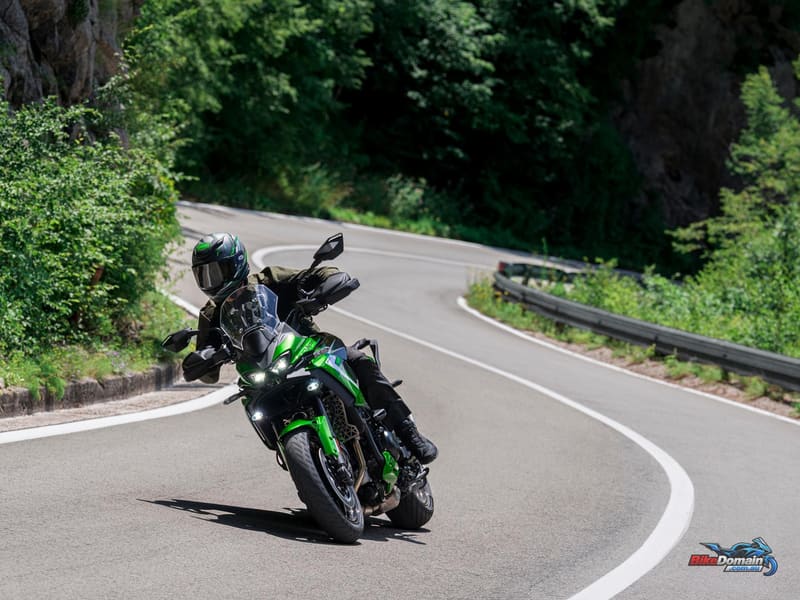
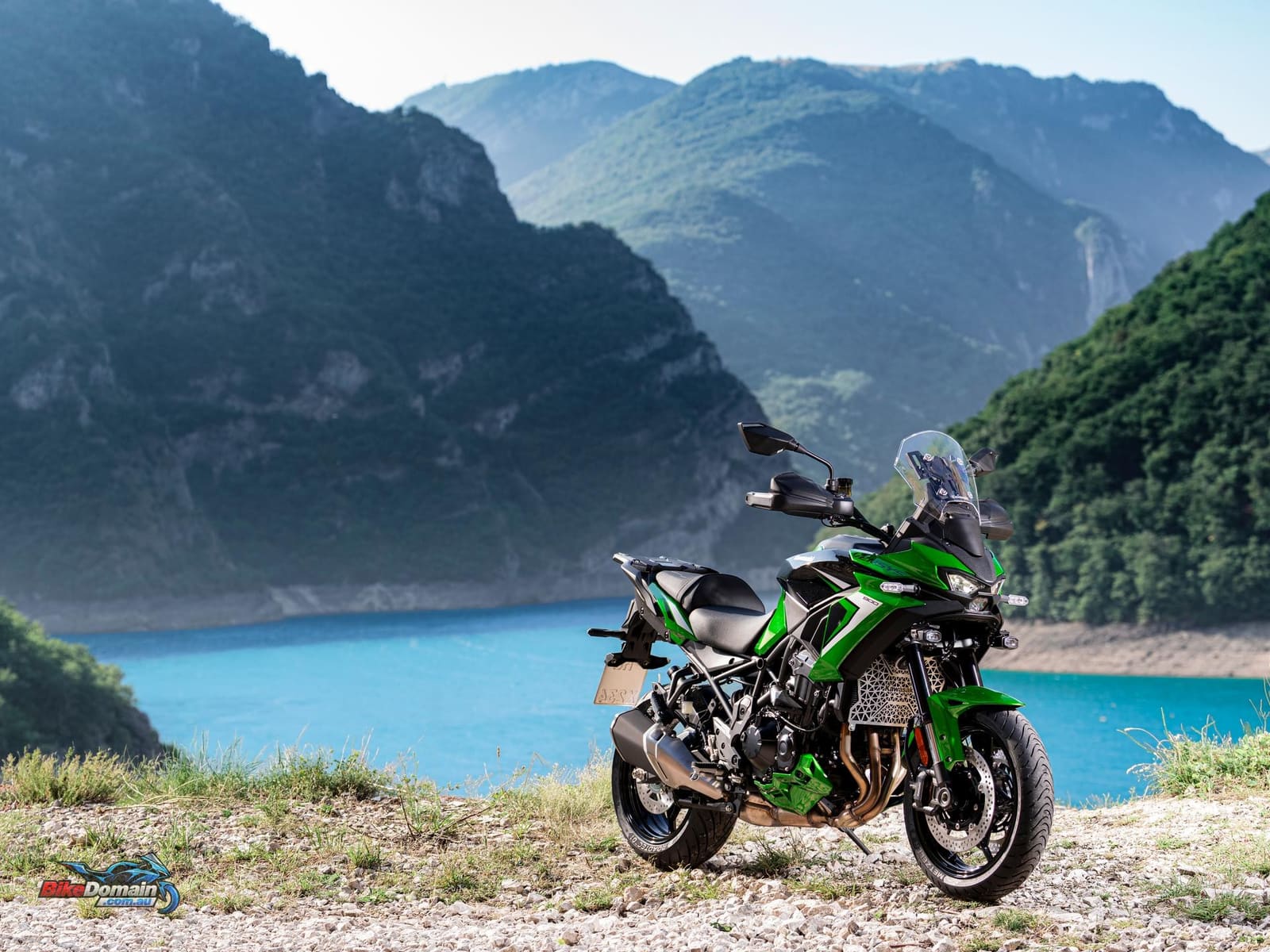
It's a road bike first. It rolls on 17-inch wheels at both ends, and German magazine Motorrad is careful to call it a crossover, not an enduro. Kawasaki's new Aero Edge styling uses layered panels meant to look as if air is flowing through the bodywork. Motorcycle.com says the nose is flatter than the Ninja-style fronts on the 650 and 1100, and New Atlas points out that the headlights come from the Z nakeds. Whether that reads as sporty or as a Versys wearing borrowed sunnies is up to you.
The engine is a Z with a touring tune
The engine is the 948 cc liquid-cooled four with double overhead cams and 16 valves, and Moto.it gives its bore and stroke as 73.4 mm by 56.0 mm. In the Versys, peak power is 122 PS, or 89.6 kW, arriving at 9,500 rpm, and peak torque is 97.3 Nm at 8,000 rpm. For comparison, Motorrad lists the current Z900 at 124 PS and 97 Nm, with its torque peak at 7,700 rpm. So the tourer gives away a couple of horses and makes its peak torque a little higher up the rev range.
Kawasaki says it tuned the intake and exhaust for this bike's job, aiming for strong, smooth torque at low and middle revs and a linear, direct response further up. Moto.it has the details:
- long, narrow intake funnels to fill out the bottom end
- an airbox redesigned to fit around the new frame
- downdraft throttle bodies with an electronic throttle
- a balancer shaft to keep vibration down
The exhaust is a four-into-one with a 5.5 litre pre-chamber under the engine, which allows a more compact silencer and helps centralise the bike's mass.
Drive goes through a six-speed gearbox with an assist and slipper clutch and a two-way quickshifter. Kawasaki fits long final gearing so the engine turns over more lazily on the highway. Moto.it gives that final drive as 42/15, which is the same final reduction Kawasaki Australia lists for the Versys 1100 S. The quickshifter works from 1,500 rpm, according to Moto.it.
There are two power modes, Full and Low, with Low at roughly three quarters of full power. You also get four riding modes, Sport, Road, Rain and a custom Rider mode, plus traction control with three levels that can be switched off. That's plenty of ways to calm down an engine that, let's be honest, was built for a hooligan naked bike.
Radar arrives on a Versys
This is the bit Kawasaki is shouting about. The Versys 900 is the first Versys with ARAS, Kawasaki's Advanced Rider Assistance Systems, run by radar sensors at the front and rear. It brings three functions:
- Adaptive Cruise Control Lite holds your set speed and slows to keep a gap to the vehicle in front, with three following distances to pick from.
- Forward Collision Warning flashes a red LED above the instruments and puts a warning on the TFT when there's a risk of running into the vehicle ahead, with three settings for how early it warns, and you can turn it off.
- Blind Spot Detection lights an LED in the mirror when a vehicle is approaching in your blind spot, and flashes it if you indicate while one is there.
The Lite part of the name matters. Kawasaki says it never touches the brakes and slows the bike through engine management alone. Cycle News points out that the full radar cruise on the Ninja H2 SX does use the brakes. So if the car ahead stands on its anchors, stopping is still your job, and Motorcycle.com notes that touching the brakes cancels the cruise control. Kawasaki says you then press the RES button to pick it back up.
There's also an Emergency Stop Signal, which flashes the brake light under hard braking to warn the driver behind. Underneath it all sits a six-axis IMU, which lets Kawasaki's cornering management adjust the traction control and ABS for lean angle.
We reckon the blind spot warning will earn its keep on multi-lane freeways, and the cruise control on the long, empty stretches between country towns. Neither replaces a head check, but both are nice to have on a bike built to cover big distances.
Chassis, comfort and the touring kit
Frame, suspension and brakes
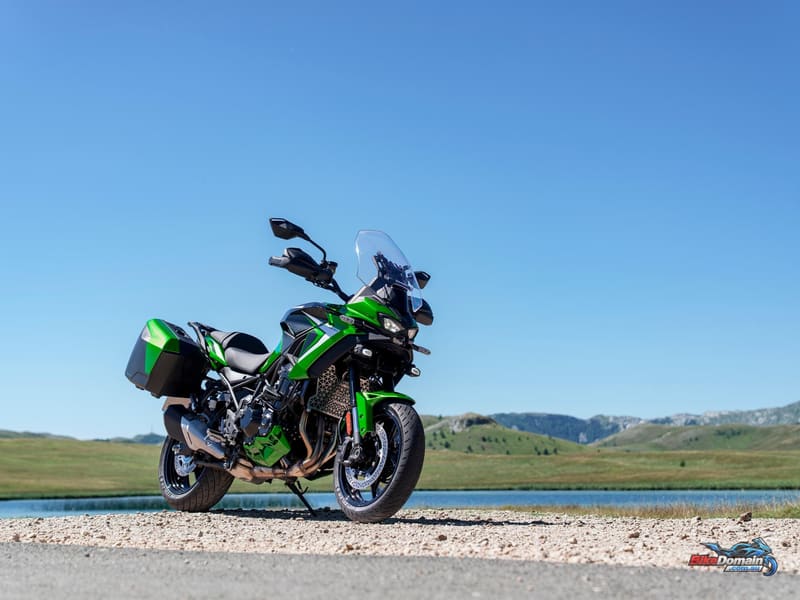
The frame is an all-new steel trellis, and the engine is a stressed member of it. Moto.it says Kawasaki started from an analysis of the Versys 1100's aluminium twin-spar frame, and the engine bolts in at five points. Motorcycle.com says the lower tubes of the rear subframe reach further down to the swingarm pivot than they do on the Z900, to carry a pillion and luggage. Moto.it puts the payload at 220 kg, the same as the 1100. The swingarm is aluminium.
Weight is split almost evenly front to rear. Moto.it says Kawasaki got there by moving the rider and the swingarm pivot forward, and by shaping the inside of the tank to push fuel towards the front. The geometry is a 24.5 degree rake, 106 mm of trail and a 1,550 mm wheelbase. Kawasaki Australia lists the 1100 S at 27.0 degrees and 1,520 mm, so the new bike has a steeper head angle on a slightly longer wheelbase.
Up front is a 43 mm upside-down cartridge fork with 150 mm of travel, adjustable for preload and rebound. The rear shock uses Kawasaki's Horizontal Back-link layout with 159 mm of travel, rebound adjustment and a remote preload knob. Its linkage sits above the swingarm, away from the heat of the exhaust. Twin 310 mm semi-floating discs with radial-mount four-piston monobloc calipers and a radial master cylinder do the stopping up front, with a 260 mm disc at the rear.
The five-spoke wheels are based on the Z900's. Kawasaki Europe lists Metzeler Roadtec 01 tyres, while the American reports from Cycle News and Motorcycle.com name the Sportec 01. We'd expect the full spec sheet to settle that one.
Seat, screen and luggage
The seat sets at 825 mm or 845 mm without tools, and the pillion gets a separate seat. The screen adjusts by hand through seven positions covering 48 mm, and Moto.it says Kawasaki ran more than a hundred wind tunnel tests to settle on its shape. A taller accessory screen sits 98 mm higher if you want more shelter.
The 5-inch colour TFT has two layouts: Type 1 puts the rev counter front and centre, and Type 2 gives more room to navigation and the radar warnings. It pairs with Kawasaki's Rideology app for turn-by-turn navigation and voice commands, and there's a USB-C port near the dash.
The accessory luggage is made by SHAD, according to Moto.it and Motorrad. There's a 47 litre top case and a pair of 32 litre panniers, and the rear frame takes all three at once. Moto.it says the top case swallows two full-face helmets, the cases share one key, and the mounts have dampers so a loaded bike stays stable at speed. For comparison, Kawasaki Australia lists the Versys 650's accessory panniers at 28 litres each.
The tank holds 20 litres, a litre less than both the 650 and the 1100 S. Kawasaki hasn't published a weight yet, and Moto.it says the weight and the full spec sheet are due in the coming weeks. Motorrad expects somewhere between 230 and 240 kg ready to ride with a full tank, but that is the magazine's estimate, not a Kawasaki figure.
Versions, prices and timing overseas
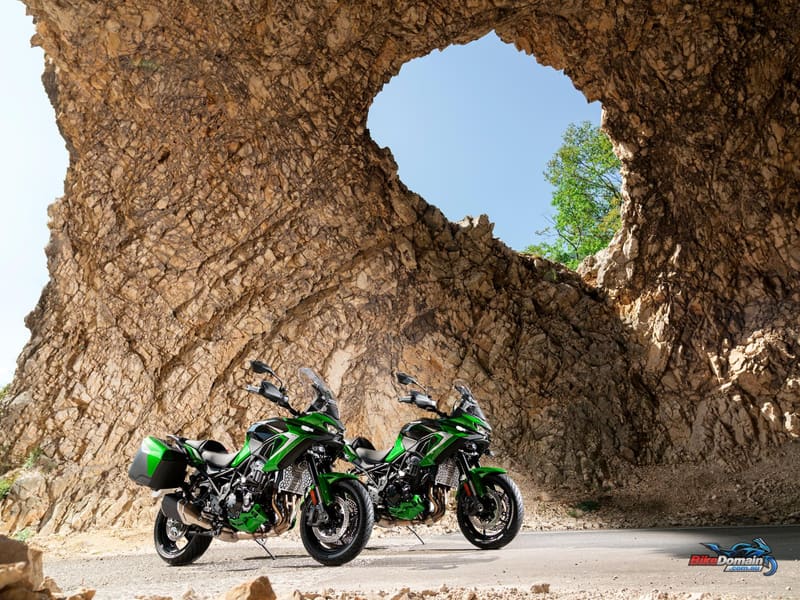
Europe gets a Standard and an SE, and both also come as a 70 kW version. Moto.it says the 70 kW bikes are aimed at riders on Europe's restricted A2 licence. They keep traction control but lose the power modes and integrated riding modes, and they cost the same as the full-power bikes.
The SE adds a bundle of genuine accessories:
- LED fog lamps and hand guards
- heated grips and a radiator screen
- frame sliders and a lower cowl
- a centre stand
Dealers will also sell Tourer and Grand Tourer editions built up with genuine accessories.
In the UK, Autocar India reports the Standard at £10,899 and the SE at £11,799, with both arriving in April 2027. Visordown gives the same 10,899 starting figure. In Italy, Moto.it lists €12,890 for the Standard and €13,790 for the SE, a €900 step it reckons makes the SE a fairly sensible buy. Motorrad reports German prices of €13,270 and €14,170 including delivery charges, with bikes due from April 2027 and the Standard in black only at first.
America does things differently. US buyers get only the Versys 900 SE LT ABS, according to Motorcycle.com. Cycle News reports a US$13,599 MSRP and a March 2027 arrival for the green and black bike. It comes with side cases as standard, along with the SE extras, though the top box is still an option. Motorcycle.com puts that between the US$10,599 Versys 650 and the US$19,799 Versys 1100 SE LT.
The press has already lined up the rivals. Cycle News names the Yamaha Tracer 900 and the Ducati Multistrada V2. New Atlas adds the Triumph Tiger 900 GT, the BMW F 900 GS and the KTM 890 Adventure, which it reckons sit closer to 105 hp, and it calls the Yamaha Tracer 9 the closest match.
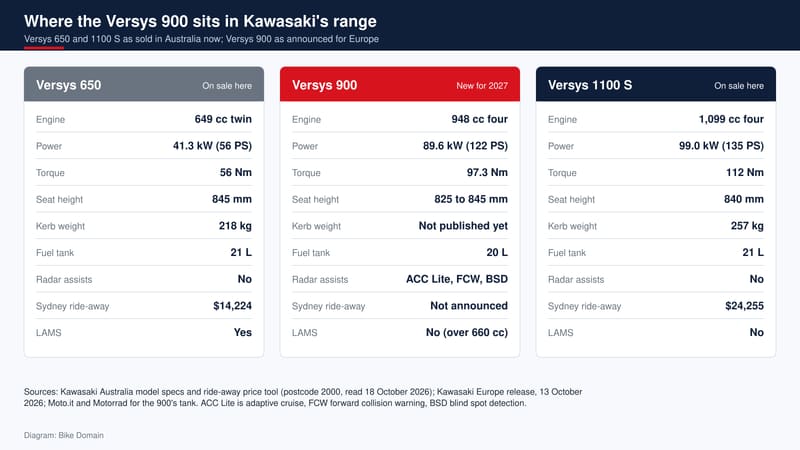
When the Kawasaki Versys 900 reaches Australia
Road Rider reported on 14 October that the standard bike and the SE should both land here and in New Zealand around the middle of 2027, with local prices, specifications and on-sale timing to come closer to launch. As of 18 October 2026, Kawasaki Australia's adventure and touring line-up still lists the Versys-X 300, the Versys 650 and the Versys 1100, with no Versys 900 page. Until there's a local price, treat the sums below as context, not a promise. We'll update this article when Kawasaki Australia confirms the details.
What the new Versys means for Australian riders
Where it would sit on price
Kawasaki Australia's own ride-away price tool, for a Sydney postcode, puts the Versys 650 at $14,224 and the Versys 1100 S at $24,255 ride-away. That's a $10,031 gap with nothing in it, and Kawasaki Australia only lists the 1100 as the S.
In the US, the new bike sits nearer the 650 than the 1100 on price: it's US$3,000 more than the 650 and US$6,200 less than the 1100 SE LT. In the UK the step up to the bigger bike is smaller. Visordown's Versys 1100 review listed the 1100 range from £11,899 for the base bike to £15,649 for the SE, with the S at £13,649. On those launch prices the UK Versys 900 Standard is £1,000 cheaper than the base 1100 and £2,750 cheaper than a 1100 S. Exchange rates and local specs make converting a mug's game, so we won't guess an Australian price.
Licence, weight and the LAMS question
It isn't a learner bike. Transport for NSW caps LAMS bikes at 660 cc and a power-to-weight ratio of 150 kW per tonne, and the Versys 900 is 948 cc. The Versys 650 stays the learner-friendly option, and Kawasaki Australia lists it as LAMS approved at 41.3 kW. If you're on your Ls or Ps, our LAMS approved bikes guide explains the scheme, and you can browse LAMS approved motorcycles for sale now.
Size could be the new bike's best local selling point. Kawasaki Australia lists the 1100 S at 257 kg with an 840 mm seat. Jeff Ware's road test for Bike Review said the big Versys "takes experience to move". The 900's lowest seat setting is 825 mm, lower than the 650's 845 mm and the 1100 S's 840 mm. If Motorrad's weight estimate is close, the 900 would also be a good deal lighter than the 1100 S, but we'll wait for Kawasaki's number before calling it.
What reviewers liked about the bigger Versys
Nobody outside Kawasaki has ridden the new bike yet, as far as we can find. The closest guide is the 1100, which shares the family recipe of long travel and 17-inch wheels but uses a bigger engine. Bike Review's Jeff Ware came away a big fan of the bigger bike.
"Kawasaki have nailed the upgrade, and at this price point, it’s one of the best value big tourers on the market."
Ware averaged 17.9 km/L on test, which he worked out at more than 370 km from the 21 litre tank. Simon Hancocks at Visordown listed it "as easy to ride as a big bike gets" among the pros, though he felt some vibration once the revs passed 7,500 rpm. Treat that as a guide to the family, not a verdict on the new bike.
What to do next
With the bike still months away from Australian showrooms, there's time to plan. You can browse Kawasaki motorcycles for sale on Bike Domain, or look at a used Versys 650 for sale or a used Versys 1000 for sale if you'd rather not wait. Our list of the top selling road touring bikes of 2025 covers the bigger tourers, and you can see every touring motorcycle for sale here too. The motorbike loan calculator shows what a new bike might cost each month. If you plan to trade up when the new Versys lands, listing your current bike early gives it time to sell first.
Sources
- Kawasaki Motors Europe, "New for 2027 Versys 900: Destination Adrenaline", news release, 13 October 2026 (a manufacturer release, so not linked)
- Kawasaki Motors Europe, Versys 900 and Versys 900 SE 2027 model pages, features and technology, read 18 October 2026 (manufacturer pages, so not linked)
- Kawasaki Motors Australia, Versys 650 and Versys 1100 S 2026 model pages and ride-away price tool for postcode 2000, read 18 October 2026 (distributor pages, so not linked)
- Robert Jones, "All-new Kawasaki Versys 900 launched with Z900-inspired engine", Visordown, 14 October 2026
- Rennie Scaysbrook, "2027 Kawasaki Versys 900 SE LT First Look", Cycle News, 14 October 2026
- Dennis Chung, "2027 Kawasaki Versys 900 SE LT First Look", Motorcycle.com, 13 October 2026
- Abhimanyu Ghoshal, "Kawasaki's beloved Versys ADV now comes in a red-hot 948cc flavor", New Atlas, 14 October 2026
- Stephen Raj Antony, "Kawasaki Versys 900 revealed", Autocar India, 14 October 2026
- Nicola Andreetto, "Ecco la Versys 900. Kawasaki svela tutto della nuova crossover: stile, dati tecnici e prezzo", Moto.it, 13 October 2026
- Maik Schwarz, "900er-Versys mit 122 PS und Radar: Kawasaki Versys 900 neu für 2027", Motorrad, 13 October 2026
- Jeff Ware, "Bike Review: 2025 Kawasaki Versys 1100 S Road Test", Bike Review, 19 August 2025
- Simon Hancocks, "2025 Kawasaki Versys 1100 Review: Touring Perfection?", Visordown, 10 December 2024
- Transport for NSW, "Learner Approved Motorcycle Scheme (LAMS)" fact sheet, PDF, read 18 October 2026
- The Road Rider Team, "Kawasaki Versys 900 coming to Australia", Road Rider, 14 October 2026

